A Motor for Your Sailboat

By Nuveen and Brooklyn Asset Management
Overview
Tax-loss harvesting has become an important part of many financial advisors' toolkits. When implemented systematically in direct index portfolios, it can add significant value through reduction of overall capital gains taxes. A 2020 MIT and Chapman University study concluded that tax-loss harvesting added as much as 1.1% to annual after-tax performance over a 92-year sample period. ¹
Traditional tax-loss harvesting, however, is dependent on market conditions. When cross-sectional volatility is low or most stocks rally, generating losses takes longer. This creates three main challenges:
Accelerating diversification of concentrated positions – Traditional methods may take too long to offset gains in concentrated positions
Rejuvenating tax-locked portfolios – Portfolios with systematic harvesting may run out of opportunities, consisting mainly of low cost-basis positions
Harvesting losses during broad-based rallies – Low dispersion environments offer limited loss harvesting opportunities
Adding a Motor
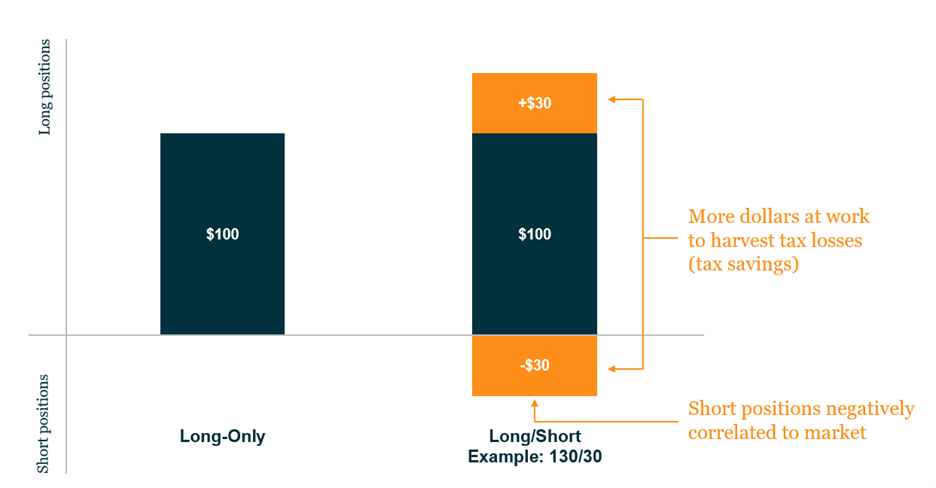
A new, more active form of tax-loss harvesting has emerged: long/short extensions. In a 130/30 example, the strategy purchases a 130% long position combined with a 30% short position, resulting in full market exposure (100%) but offering more opportunities for tax-loss harvesting.
This method provides benefits through two avenues (Exhibit 1):
More dollars to harvest – The notional portfolio value is greater, enabling larger tax-loss harvesting in dollar terms
Negative correlation – Short positions can enable tax-loss harvesting even when all stocks rise simultaneously, though they carry additional risks including unlimited loss potential (see Risks and Important information on risk sections).
Exhibit 1: What is tax-advantaged long/short?
Long/short strategies offer potential for higher and longer-lasting tax alpha versus traditional long-only strategies. The simulated averages in Exhibit 2 illustrate the potential for higher and longer lasting tax alpha using long/short strategies vs. long-only. The funding source used is cash and the benchmark is the S&P 500 Index.2
Exhibit 2: Tax savings simulation

Need for an Experienced Captain
Unlike traditional tax-loss harvesting's mechanical approach, enhanced strategies require active management. Success requires:
Investment management to select securities ensuring long positions outperform shorts
Appropriate risk models to prevent undesirable factor bets
Frequent, ongoing monitoring of the long/short book
Execution cost control by incorporating short availability and borrow costs
Investment Views & Risk Management
Establishing a long/short extension requires security selection since long and short positions cannot be maintained in the same securities. While some managers use traditional risk factors, we believe uncorrelated alpha signals selected to work with tax-loss harvesting objectives provide better results.
Proper risk management is essential. Long/short extensions create new risks, particularly from large stock-specific shocks. Short position losses are unlimited, unlike long positions capped at -100%. Portfolio managers must monitor risks daily, neutralize unwanted systematic risk, and ensure proper diversification with position-level constraints.
Risks
Associated risks include idiosyncratic risk, short-sale risk, borrow risk (potential "short squeeze"), leverage risk, and cost of borrow—particularly for thinly traded stocks.
Conclusion
Tax-loss harvesting can be further enhanced through long/short extensions. While not always the right solution—requiring substantial assets (typically $1M minimum), a margin account with the right custodian, and experienced management—using long/short extensions is like adding a motor to your sailboat. It can help you reach your destination faster, across different market conditions.
About Us
Nuveen's personalized managed account solutions combine industry expertise with innovative thinking, leveraging Brooklyn Investment Group's advanced technology to deliver institutional-grade portfolio optimization and automated tax-loss harvesting — creating tailored investment strategies that scale to meet each client's unique needs.

¹ Chaudhuri, Shomesh and Burnham, Terence C. and Lo, Andrew W., 2020, An Empirical Evaluation of Tax-Loss Harvesting Alpha, Financial Analysts Journal, Volume 76, Issue 3.
2 For more details on simulation assumptions, see the Simulation Methodology Explanation slide proceeding this section. Illustrations are constructed by drawing on five 5-year backtest simulations, starting from 12/31/2015 to 12/31/2024. No representation is being made that any account will or is likely to achieve similar results. The realized tax benefits associated with any tax-aware strategy may be less than expected or may not materialize due to the economic performance of the strategy, an investor's particular circumstances, prospective or retroactive changes in applicable tax law, and/or a successful challenge by the IRS. Please also see the Disclosures at the end of this document.
Important information on risk
This material, along with any views and opinions expressed within, are presented for informational and educational purposes only as of the date of production/writing and may change without notice at any time based on numerous factors, such as changing market, economic, political, or other conditions, legal and regulatory developments, additional risks and uncertainties and may not come to pass. There is no promise, representation, or warranty (express or implied) as to the past, future, or current accuracy, reliability or completeness of, nor liability for, decisions based on such information, and it should not be relied on as such. This material should not be regarded by the recipients as a substitute for the exercise of their own judgment.
This material is not intended to be a recommendation or investment advice, does not constitute a solicitation to buy, sell or hold a security or investment strategy and is not provided in a fiduciary capacity. The information provided does not take into account the specific objectives or circumstances of any particular investor, or suggest any specific course of action. Investment decisions should be made based on an investor’s objectives and circumstances and in consultation with their financial advisors. Financial professionals should independently evaluate the risks associated with products or services and exercise independent judgment with respect to their clients.
This material does not constitute a solicitation of an offer to buy, or an offer to sell securities in any jurisdiction in which such solicitation is unlawful or to any person to whom it is unlawful to make such an offer. Moreover, it neither constitutes an offer to enter into an investment agreement with the recipient of this document nor an invitation to respond to it by making an offer to enter into an investment agreement. This material may contain “forward-looking” information that is not purely historical in nature. Such information may include, among other things, projections, forecasts, estimates of yields and/or market returns, and proposed or expected portfolio composition. Moreover, certain historical performance information of other investment vehicles or composite accounts managed by Brooklyn/Nuveen may be included in this material and such performance information is presented by way of example only. No representation is made that the performance presented will be achieved, or that every assumption made in achieving, calculating or presenting either the forward-looking information or the historical performance information herein has been considered or stated in preparing this material.
Economic and market forecasts are subject to uncertainty and may change based on varying market conditions, political and economic developments. Any changes to assumptions that may have been made in preparing this material could have a material impact on any of the data and/or information presented herein by way of example. Brooklyn/Nuveen assumes no duty to and does not undertake to update forward-looking statements.
Past performance is no guarantee of future results. All investments carry a certain degree of risk, including the possible loss of principal, and there is no assurance that an investment will provide positive performance over any period of time. Certain products and services may not be available to all entities or persons. There is no guarantee that investment objectives will be achieved. See the applicable product literature for details. Equity investments are subject to market risk or the risk that stocks will decline in response to such factors as adverse company news or industry developments or a general economic decline. In addition, growth stocks or growth investing may fall out of favor and underperform value stocks and other investing styles over any period of time. Certain sectors or growth stocks may shift characteristics over a long market cycle and may not perform inline with stated benchmarks. Investments in foreign securities are subject to special risks, including currency fluctuation and political and economic instability. These risks are often heightened for investments in emerging markets.
The following risks are associated with long/short strategies and must be communicated to any end client on whose behalf such strategy is to be utilized: Market risk can lead to loss due to the impact of general market movements. Idiosyncratic risk, due to company-specific factors that are generally not correlated with the broad market environment, can lead to loss. Short-sale risk can amplify losses if the stock price appreciates. Borrow risk can result in a “short squeeze,” meaning that securities borrowed with a short sale need to be returned to the securities lender on short notice and at a time when other short sellers of the security are receiving similar requests, compelling the end client to buy such securities on the open market at prices significantly in excess of the proceeds received, which can lead to loss. Leverage risk, due to time-varying correlations that introduce unexpected net exposures between longs and shorts, resulting in improper portfolio hedging. Investors using leverage should realize that one can lose the full balance of their account. It is also possible to lose more than the initial deposit when using leverage. All funds committed should be purely risk capital. Borrow rate risk for stocks can lead to loss.
Tracking error risk: Tracking error risk refers to the risk that the performance of a client portfolio may not match or correlate to that of the index it attempts to track, either on a daily or aggregate basis. Factors such as fees and trading expenses, client-imposed restrictions, tax-loss harvesting, imperfect correlation between the portfolio’s investments and the index, changes to the composition of the index, regulatory policies, and high portfolio turnover all contribute to tracking error. Tracking error risk may cause the performance of a client portfolio to be less or more than expected.
Tax-managed investing risk: Investment strategies that seek to enhance after-tax performance may be unable to fully realize strategic gains or harvest losses due to various factors. Any reduction in taxes will depend on an investor’s specific tax situation. Market conditions may limit the ability to generate tax losses. A tax-managed strategy may cause a client portfolio to hold a security in order to achieve more favorable tax treatment or to sell a security in order to create tax losses. A tax loss realized by a U.S. investor after selling a security will be negated if the investor purchases the security within thirty days. Although portfolio managers can seek to avoid such a “wash sales” and temporarily restrict securities sold at a loss within the same portfolio, a wash sale can inadvertently occur for a variety of factors, including trading in other accounts, including accounts managed by the same investment adviser, client-directed activity and account contributions, withdrawals or rebalancing. Investment strategies that employ tax-loss harvesting also involve the risk that a replacement investment could perform worse than the original investment and that such factor, as well as transaction costs, could offset any potential tax benefit. This piece provides general tax information and should not replace a client’s consultation with a tax professional regarding their tax situation. Neither Nuveen nor Brooklyn Investment Group, LLC can offer tax advice. Nuveen and Brooklyn are not tax professionals. Investors should discuss the implications of tax-managed strategies, including but not limited to, the suitability and likely tax treatment of the long/short strategies in their particular circumstances, with their tax and financial professional before making any tax or investment decisions. Tax rates and IRS regulations are subject to change at any time, which could materially affect the information provided herein. Tax treatment of the long/short strategies cannot be guaranteed, may constitute deferral, and may not be suitable for all end clients to pursue.
Important information on hypothetical risk
As used herein, “targeted” returns or characteristics refer to ex-ante objectives in the portfolio management process; whereas “expected” returns or characteristics refer to expectations based on the application of mathematical principles to portfolio attributes and/or historical data, and does not represent a guarantee. There is no guarantee that targeted or expected returns or other characteristics will be realized or achieved, or that an investment strategy will be successful.
Brooklyn seeks to expeditiously and efficiently effect sales of legacy securities contributed to new or existing accounts or in connection with termination and liquidation instructions, generally by directing the execution of sale to the relevant broker-dealer/custodian designated by the client’s managed account program, subject to program limitations. Primarily due to the time constraints and lot sizes applicable to these transactions, and because the full range of trading techniques is generally not available (including aggregation), the prices received in these transactions may be less favorable than the prices that could be attained for sales of securities selected by Brooklyn as part of ongoing management. Clients always reserve the right to fund accounts with cash as opposed to legacy securities and to keep any securities in their accounts if terminating Brooklyn’s services.
Certain investment personnel may concurrently provide services for more than one affiliate, which may produce conflicts in the services provided.
Hypothetical performance results have many inherent limitations, some of which are described below. No representation is being made that any account will or is likely to achieve profits or losses similar to those shown. In fact, there are frequently sharp differences between hypothetical performance results and the actual results subsequently achieved by any particular trading program.
One of the limitations of hypothetical performance results is that they are generally prepared with the benefit of hindsight. In addition, hypothetical trading does not involve financial risk, and no hypothetical trading record can completely account for the impact of financial risk in actual trading. For example, the ability to withstand losses or to adhere to a particular trading program in spite of trading losses are material points which can also adversely affect actual trading results. There are numerous other factors related to the markets in general or to the implementation of any specific trading program which cannot be fully accounted for in the preparation of hypothetical performance results and all of which can adversely affect actual trading results.
The hypothetical performance results contained herein represent the application of the quantitative models as currently in effect on the date first written above and there can be no assurance that the models will remain the same in the future or that an application of the current models in the future will produce similar results because the relevant market and economic conditions that prevailed during the hypothetical performance period will not necessarily recur. Discounting factors may be applied to reduce suspected anomalies. This backtest’s return, for this period, may vary depending on the date it is run. Hypothetical performance results are presented for illustrative purposes only. In addition, our transaction cost assumptions utilized in backtests, where noted, are based on Brooklyn’s historical realized transaction costs and market data. Certain assumptions have been made for modeling purposes and are unlikely to be realized. No representation or warranty is made as to the reasonableness of the assumptions made or that all assumptions used in achieving the returns have been stated or fully considered. Changes in the assumptions may have a material impact on the hypothetical returns presented. Actual advisory fees for products offering this strategy may vary.
The S&P 500 Index is a product of S&P Dow Jones Indices LLC or its affiliates (“SPDJI”) and has been licensed for use by Brooklyn Artificial Intelligence, Inc. and its affiliate, Brooklyn Investment Group, LLC. S&P, S&P 500, US 500, The 500, iBoxx, iTraxx and CDX are trademarks of S&P Global, Inc. or its affiliates (“S&P”); Dow Jones is a registered trademark of Dow Jones Trademark Holdings LLC (“Dow Jones”); and these trademarks have been licensed for use by SPDJI and sublicensed for certain purposes by Brooklyn Artificial Intelligence, Inc. and its affiliate, Brooklyn Investment Group, LLC. Licensee’s Product(s) are not sponsored, endorsed, sold or promoted by SPDJI, Dow Jones, S&P, their respective affiliates and none of such parties make any representation regarding the advisability of investing in such product(s) nor do they have any liability for any errors, omissions, or interruptions of the S&P 500 Index.
Brooklyn Investment Group, LLC is an SEC-registered investment adviser and a wholly-owned subsidiary of Brooklyn Artificial Intelligence, Inc. Brooklyn Investment Group, LLC (“Brooklyn”) and its parent company Brooklyn Artificial Intelligence, Inc. are subsidiaries of Nuveen, LLC, a subsidiary of Teachers Insurance and Annuity Association of America (also known as “TIAA”). Brooklyn is an affiliated investment adviser of Nuveen Asset Management, LLC (“NAM”).